Luminance (in)stability in OLED monitors: Difference between revisions
No edit summary |
No edit summary |
||
| Line 5: | Line 5: | ||
== Luminance measurement method == | == Luminance measurement method == | ||
Luminance measurements were taken using a photodiode (OSRAM SFH2240-A01) which was connected to a micro-controller (RaspberryPi RP2350) via a trans-impedance amplifier. The RP2350 offers a 12bit analog-digital converter, which was operated at 480{{unit|ksps}}. However, data was down-sampled to 16bit at 20{{unit|kHz}} before | Luminance measurements were taken using a photodiode (OSRAM SFH2240-A01) which was connected to a micro-controller (RaspberryPi RP2350) via a trans-impedance amplifier. The RP2350 offers a 12bit analog-digital converter, which was operated at 480{{unit|ksps}}. However, data was down-sampled to 16bit at 20{{unit|kHz}} before making it available to the PC. The photodiode, which was housed in a small enclosure together with the other electronics, was placed over a 5x5{{unit|mm}} target stimulus at the screen center, at a distance of about 2.5{{unit|mm}} from the screen surface. | ||
A thin foam rubber layer applied to the enclosure's surface, surrounding the enclosure's photodiode cutout, reliably shadowed ambient light. Moreover, the target stimulus was always placed on a black 35x35{{unit|mm}} square for preventing light emitted by the global background pattern from bleeding into the target area through the screen's cover layer. | |||
The stimulus presentation and final luminance sampling followed a 4{{unit|Hz}} clock. In essence, each 4{{unit|Hz}} sampling cycle started with updating the screen image buffer, whether the image content actually changed or not. Photodiode samples that happened to fall in this sampling cycle were averaged, ignoring samples that could be potentially contaminated by the content of the previous or the next image, assuming an image settling time that depended on the monitor technology (e.g., a generous 10{{unit|ms}} for OLED monitors, or 40{{unit|ms}} for the (fast) TN and IPS monitors). | |||
The stimulus presentation and final luminance sampling followed a 4{{unit|Hz}} clock. In essence, each 4{{unit|Hz}} sampling cycle started with | |||
== Test stimuli == | == Test stimuli == | ||
| Line 17: | Line 15: | ||
[[File:LumStab_BgPatterns.png|link={{filepath:LumStab_BgPatterns.png}}|right|thumb|450px|<caption>Possible background patterns.</caption>]] | [[File:LumStab_BgPatterns.png|link={{filepath:LumStab_BgPatterns.png}}|right|thumb|450px|<caption>Possible background patterns.</caption>]] | ||
</figure> | </figure> | ||
There were several | There were several tests, each with its specific stimulus configuration comprising of a measured target at the screen center and the background covering the rest of the screen. In principle, the measured target was either small or big (5x5 or 35x35{{unit|mm}}), and its luminance could be constant over time or changing. The background either changed between different static patterns (see <xr id="BgPatterns" nolink />), or it was just all black or all mid-gray throughout, or it was slowly ramped up from black to white and then back down from white to black. | ||
{{clr}} | {{clr}} | ||
== Test protocol == | == Test protocol == | ||
The entire test sequence was run automatically, but the single tests were otherwise independent | The entire test sequence was run automatically, but the single tests were otherwise independent. Before each test, a quick gamma curve was measured, basically for inferring the pixel values that needed to be programmed for mid-gray (i.e., 50% of the maximum luminance). | ||
For each test, 5 repetitions of 2 to 4 minute long sweeps were measured. The stimulus sequence within a sweep, even if randomized, was exactly the same for all sweep repetitions (and for all monitors). For example, if the background was changed randomly from time to time, this random sequence of background patterns and the duration of each pattern was kept the same for all sweeps for all monitors. Before each sweep, a black screen was presented for 10 seconds, which was supposed to somewhat reset the state of the screen pixels and monitor | For each test, 5 repetitions of 2 to 4 minute long sweeps were measured. The stimulus sequence within a sweep, even if randomized, was exactly the same for all sweep repetitions (and for all monitors). For example, if the background was changed randomly from time to time, this random sequence of background patterns and the duration of each pattern was kept the same for all sweeps for all monitors. Before each sweep, a black screen was presented for 10 seconds, which was supposed to somewhat reset the state of the screen pixels and monitor control electronics. For a single monitor, the data collection took about 37 minutes. | ||
== Analysis == | == Analysis == | ||
Very slow luminance changes are of no interest here, which is why luminance drift was removed from each sweep. The drift was modeled by a smoothing quadratic spline with support points about every 60{{unit|s}}. For 2-minute sweeps, for example, this resulted in 4 coefficients per sweep, which included the coefficients for the boundary conditions at the sweep start and end. Because such drift model is too flexible for preserving systematic luminance changes which are of interest in the BgRamp+TgtSmallWhite test (see below), the spline-based drift model was replaced by a simple linear drift model for this specific test. | Very slow luminance changes are of no interest here, which is why luminance drift was removed from each sweep. The drift was modeled by a smoothing quadratic spline with support points about every 60{{unit|s}}. For 2-minute sweeps, for example, this resulted in 4 coefficients per sweep, which included the coefficients for the spline boundary conditions at the sweep start and end. Because such drift model is too flexible for preserving systematic luminance changes which are of interest in the BgRamp+TgtSmallWhite test (see below), the spline-based drift model was replaced by a simple linear drift model for this specific test. | ||
{{clr}} | {{clr}} | ||
<figure id="RelLumSteps" noblock> | <figure id="RelLumSteps" noblock> | ||
Revision as of 15:53, 4 June 2026
Topic
It is well known that OLED monitors down-regulate image luminance if, otherwise, the average image luminance would exceed a limit that cannot be handled by the monitor on the long run. However, luminance variation due to this luminance limitation control is not what shall be discussed here. Instead, this page is about luminance stability when the monitor is not only set to the "uniform brightness" mode but also operated well below the maximum luminance specified for the uniform brightness mode. One major difference between LCD and OLED technology is that, in LCD monitors, the light comes from a constant backlight and the pixel cells just control how much of the backlight can pass, whereas in OLED monitors, the light is directly generated by the pixels – on demand, so to speak. Assuming that the bulk of the monitor's energy consumption is spent on the pixels' luminous output, the energy demand in LCD monitors is rather constant and much easier to control than in OLED monitors, where energy demand is tightly coupled to the image content and can rapidly change from one image frame to the next. Moreover, this control of the overall OLED current not only has to be fast but also very accurate, given that there is no cancelling out of errors through averaging across the OLED pixels – that is, a 1% error in the overall current directly results in a 1% pixel luminance error for each single pixel. The practical relevance of potentially unstable pixel luminance totally depends on the application, e.g. how fast and to what extent the (intended) image luminance is changing, and how stable the luminance of a potential target stimulus has to be.
Luminance measurement method
Luminance measurements were taken using a photodiode (OSRAM SFH2240-A01) which was connected to a micro-controller (RaspberryPi RP2350) via a trans-impedance amplifier. The RP2350 offers a 12bit analog-digital converter, which was operated at 480 ksps. However, data was down-sampled to 16bit at 20 kHz before making it available to the PC. The photodiode, which was housed in a small enclosure together with the other electronics, was placed over a 5x5 mm target stimulus at the screen center, at a distance of about 2.5 mm from the screen surface.
A thin foam rubber layer applied to the enclosure's surface, surrounding the enclosure's photodiode cutout, reliably shadowed ambient light. Moreover, the target stimulus was always placed on a black 35x35 mm square for preventing light emitted by the global background pattern from bleeding into the target area through the screen's cover layer.
The stimulus presentation and final luminance sampling followed a 4 Hz clock. In essence, each 4 Hz sampling cycle started with updating the screen image buffer, whether the image content actually changed or not. Photodiode samples that happened to fall in this sampling cycle were averaged, ignoring samples that could be potentially contaminated by the content of the previous or the next image, assuming an image settling time that depended on the monitor technology (e.g., a generous 10 ms for OLED monitors, or 40 ms for the (fast) TN and IPS monitors).
Test stimuli
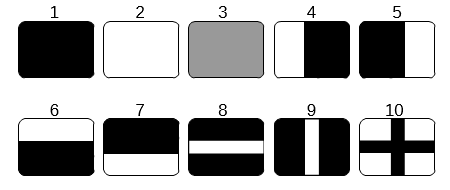

There were several tests, each with its specific stimulus configuration comprising of a measured target at the screen center and the background covering the rest of the screen. In principle, the measured target was either small or big (5x5 or 35x35 mm), and its luminance could be constant over time or changing. The background either changed between different static patterns (see Figure 1), or it was just all black or all mid-gray throughout, or it was slowly ramped up from black to white and then back down from white to black.
Test protocol
The entire test sequence was run automatically, but the single tests were otherwise independent. Before each test, a quick gamma curve was measured, basically for inferring the pixel values that needed to be programmed for mid-gray (i.e., 50% of the maximum luminance).
For each test, 5 repetitions of 2 to 4 minute long sweeps were measured. The stimulus sequence within a sweep, even if randomized, was exactly the same for all sweep repetitions (and for all monitors). For example, if the background was changed randomly from time to time, this random sequence of background patterns and the duration of each pattern was kept the same for all sweeps for all monitors. Before each sweep, a black screen was presented for 10 seconds, which was supposed to somewhat reset the state of the screen pixels and monitor control electronics. For a single monitor, the data collection took about 37 minutes.
Analysis
Very slow luminance changes are of no interest here, which is why luminance drift was removed from each sweep. The drift was modeled by a smoothing quadratic spline with support points about every 60 s. For 2-minute sweeps, for example, this resulted in 4 coefficients per sweep, which included the coefficients for the spline boundary conditions at the sweep start and end. Because such drift model is too flexible for preserving systematic luminance changes which are of interest in the BgRamp+TgtSmallWhite test (see below), the spline-based drift model was replaced by a simple linear drift model for this specific test.
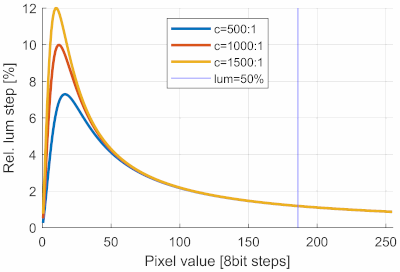

The blue vertical line indicates where the luminance reaches 50% of the maximum luminance. All tests use target luminances higher than 50%, where the relative luminance step sizes are about 1% and are essentially independent of the monitor's white contrast.
Also of no interest are the absolute luminance levels, which is why the luminance error is expressed as relative luminance error, i.e., the difference between the measured and the expected luminance, divided by the expected luminance. The expected luminance was defined as the average luminance across all measurements taken within a sweep for the respective target luminance. This definition of relative luminance error closely reflects what is also perceptually relevant; a 1% relative luminance error is perceptually as large in dark stimuli as in bright stimuli, even though the corresponding absolute luminance errors differ.
For the quantitative evaluation of the relative luminance error values, a comparison with the relative luminance step size in a gamma transfer function might be useful. Unfortunately, the step sizes depend on the assumed gamma value, white-contrast, and pixel value. Figure 1 shows curves for gamma=2.2 and three different contrast levels. For the test described here, which mostly use a 100%-white target or at least a target with a luminance above 50% of maximum white, an 8 bit step corresponds to a relative step size of roundabout 1%. A uniform distribution of an according luminance error would have an SD of 1%/sqrt(12) ≈ 0.3%. This means that, at least for higher pixel values, the relative luminance error just caused by 8 bit quantization is 0.3%. However, this a theoretical value and does not include round-off noise introduced by the color processing in the monitor.